
This article was first published in the April, 2024 issue of The Homesteader.
A Rough Character – In the early days, The Bend Bulletin would list the out-of-town guests staying at the various lodgings in the city. These “At the Hotels” columns indicate that in the late nineteen-teens an occasional visitor to Bend was “Lee Collins” from Silver Lake. If you were to belly up to a lunch counter back then and sit next to Collins you’d likely get the heebie-jeebies when he turned to acknowledge you. Collins was a rough character and had the unnerving mannerism of speaking rapidly through clenched teeth with his lips drawn back into a macabre, toothy smile. He slurred the ends of his words in a hissing, hurried chatter. In his mid-thirties and a compact five foot seven, 160 pounds, this customer was toughened and gnarled from a hard life of working as a ranch hand, teamster, logger, bootlegger, sheep herder and fur trapper. After Collins paid his tab and walked towards the door you’d observe that his gait was noticeably quick and herky-jerky. Fast forward to April 24, 1924 and you wouldn’t be surprised by headlines declaring that the unsettling stranger you crossed paths with was suspected of committing three murders at a remote mountain lake in the Cascades. By that time he was identified in the press by his real name: Charles Kimzey.
Kimzey was on the lam from the Idaho State Penitentiary, having escaped in 1915 while serving a 3 to 14 year stint for larceny. His many aliases included Lee Collins, Tom Collins, Bob Dales, Tom Rose, W.R. Howe and William Becker. He roamed throughout Montana, Idaho, Utah and eastern Oregon and in the early 1920s drifted into Deschutes County.
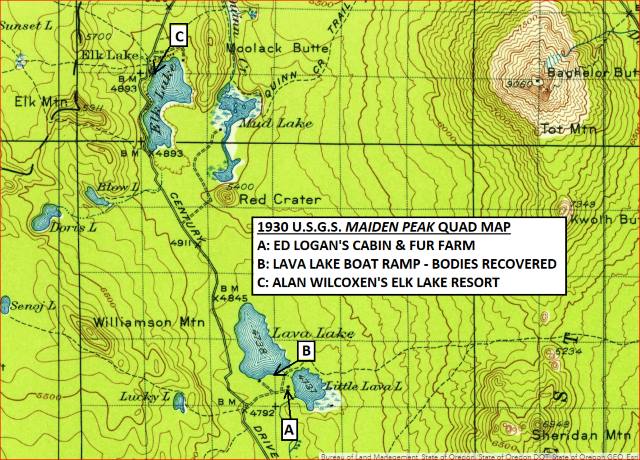
1922-1923 in the High Lakes – In 1922, Alan Willcoxon was building a resort and cabins at Elk Lake. The road from Bend to the lake had just been improved and the high lakes were becoming a popular recreation destination. Five miles south of Elk Lake, prominent Bend logging contractor Ed Logan had a trappers’ cabin and fur farm at Little Lava Lake. In 1922 and 1923 Kimzey worked for both Willcoxon at Elk Lake and Logan at Little Lava Lake. During the winter, he also partnered with Bend resident Ed Nichols running traplines in the Cascades while tending to Logan’s penned foxes at Little Lava Lake.
Near the end of the summer of 1923 Kimzey and Ed Nichols got into a heated quarrel when Nichols accused Kimzey of stealing $500 from him. Soon thereafter, on August 20, 1923, Kimzey caught a ride to Bend from Little Lava Lake with his employer Ed Logan. Once Logan headed back to the lake, Kimzey broke into Logan’s home in Bend and stole a trunk containing an expensive fur coat and a diamond ring.
Kimzey had the trunk freighted to Boise, Idaho and the next morning hired cabbie W. E. Harrison to drive him to a deserted homestead near Frederick Butte, about 15 miles southeasterly of the town of Brothers. The purpose of the trip was ostensibly to purchase horses. Once at the deserted ranch Kimzey cracked Harrison on the back of the head, knocking him unconscious. He bound Harrison’s ankles and wrists with bailing wire and started dragging him towards an empty cistern. Harrison resumed consciousness and was forced to drink a vial of either some sort of drug or poison. Harrison passed out again and Kimzey threw him headfirst into the seven-foot-deep cistern.
Harrison survived and after coming to, it took him hours to unbind his hands and feet and clamber out of the well. He walked four miles to a ranch and the sheriff was summoned. Kimzey was long gone. The stolen car, with license plates on it that Kimzey had stolen from one of Ed Logan’s cars, was later found abandoned in Boise, as was Ed Logan’s trunk, emptied of its expensive contents. The fur coat was later found by police in a Boise pawn shop.
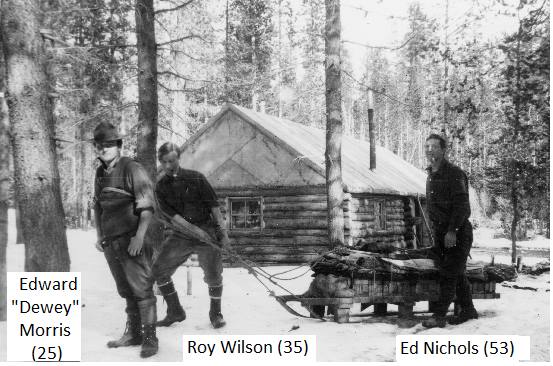
The Three Trappers – In the fall of 1923 Ed Nichols was employed by Logan to tend to the Little Lava Lake fur farm through the winter. Logan had a pen with five very valuable foxes that Nichols was to feed and care for. Two of Nichols’ friends decided to join him for the winter and run about 30 miles of trap lines through the Cascades. The three trappers wintering over at the Little Lava Lake cabin in 1923-1924 were:
Edward K. “Ed” Nichols (or “Nickols”): A 53-year-old divorcee and father of two. He had been a blacksmith and a logger and more recently worked as a trapper and horse packer.
Harry Leroy “Roy” Wilson: A 36-year-old ex-Marine. He was single and worked as a logger for Brooks-Scanlon. The Wilson family apparently had ties to Ed Nichols’ family, having previously lived in Bellingham, Washington and in northern Lake County, Oregon during the same time frame.
Dewey Morris: A 24-year-old logger. His brothers Owen, Ben and Donald lived in Central Oregon, as did his sister Janeva B. Carrol. Dewey and Owen were employed by Brooks-Scanlon.
Why did Wilson and Morris decide to spend the winter trapping with Ed Nichols? Severe weather often slowed down or completely halted woods work. Trapping could be profitable in a good season. Another possibility was concern for their friend Ed Nichols’ safety. He had told Ed Logan that after the row with Kimzey over the theft of his $500, Kimzey said he would come back some day and kill Nichols. Nichols lived in fear of reprisal by Kimzey.
Once the trappers got the cabin stocked up in autumn and the snow began to fall, the only way in or out was by snowshoe. The easiest way to get to Little Lava Lake in the winter was by driving from the Fall River/Crane Prairie area as far as the snow allowed and then snowshoeing up the Snow Creek drainage to the lake. This could be anywhere from a 5 to 25 mile trudge, depending on the snowline.
Just before Christmas Ed Nichols made the trip out on snowshoes and brought a pack full of furs to Bend. He reported that all was well at the lake and the fur take was plentiful. Apparently Morris and Wilson also visited Bend some time during the holidays and Wilson told his mom they’d likely return to town before Easter.
January 1924 – The entire crew was back at the cabin by January 1 and on the 15 they entertained a visitor. Allen Willcoxon had snowshoed 24 miles from his home at Fall River, heading to Elk Lake to see how his cabins were fairing under the heavy winter snows. It was late in the day when he arrived at Little Lava so he stayed overnight with the trappers, exchanging stories till the wee hours of the morning. He continued on to Elk Lake in the morning and returned back to Fall River via a different route. He reported that the trappers were comfortable and contented with their fur catch.
April 1924 – Not a word had been heard from the trappers since January 15, so on April 13, 1924, Roy Wilson’s brother-in-law, H.D. Innis, and Dewey Morris’s brother Owen snowshoed up to the cabin. The scene was disturbing. The trappers were absent. An emaciated cat bolted out the cabin door. The breakfast table was set and moldy, burnt food was in pots and pans atop the cold cook stove. The calendar page was still turned to January. Cold weather hats and coats along with guns and traps were still in the cabin so it did not appear the trappers had ventured out to their trap lines. There was no sign of a struggle in the cabin, but it was messy, like it had been rifled through. The five foxes were missing from the pens, as were the two tote sleds. Any furs the trappers had harvested were gone. Innis and Morris hot-footed it back to town.

On April 14, Pearl Edward Lynes returned to the lake with Innis and Morris to help search. On April 15 Dewey’s other brothers Don and Ben arrived with Deputy Sheriff and game warden Clarence Adams. In the next week the traplines and three other trappers’ cabins were searched with no trace of the men. Unattended traps held the frozen remains of 12 martins and 4 foxes. The carcasses of the five penned foxes were found near the cabin. Two had been expertly skinned and the others were bungled… indicating that two people of varying skill had skinned them. Finds around the cabin started to paint a gruesome picture. Bloody snow. A human tooth. A bit of skull. A bloody hammer. Expended shotgun shells and revolver brass.
A quarter mile from Little Lava Lake near the boat launch of (big) Lava Lake one of the trappers’ tote sleds was found by the shore. It had human blood on it. A faint trail led out over the frozen lake about 100 yards to a frozen-over hole that had been chopped in the ice. It was all too apparent what had happened to the trappers.
On the afternoon of April 23, Lava Lake suddenly thawed and gave up her dead. The three trappers’ bodies were sighted floating a couple hundred feet out in the lake. The bodies were taken back to Bend on April 24, examined by the coroner, and on April 25 buried in Greenwood Cemetery.
The findings of the coroner’s inquest is the least gruesome description you’ll read of how the trappers died, so it will suffice for this account: “We… find that they all came to their death… in the following manner: Ed Nichols was killed by a shotgun wound. Roy Wilson was killed by a bullet wound through the head. He was also shot with a shotgun. Dewey Morris was killed by being hit on the head with some blunt instrument. He was also shot with a shotgun. All these men were killed by a person or persons unknown to this jury.”
It was speculated that two men slaughtered the trappers by luring them out of the cabin into an ambush. The trappers didn’t put on coats or take weapons out of the gun racks. Did they get hailed from outside by a familiar voice? Did they hear the penned foxes raising a ruckus? We will never know.
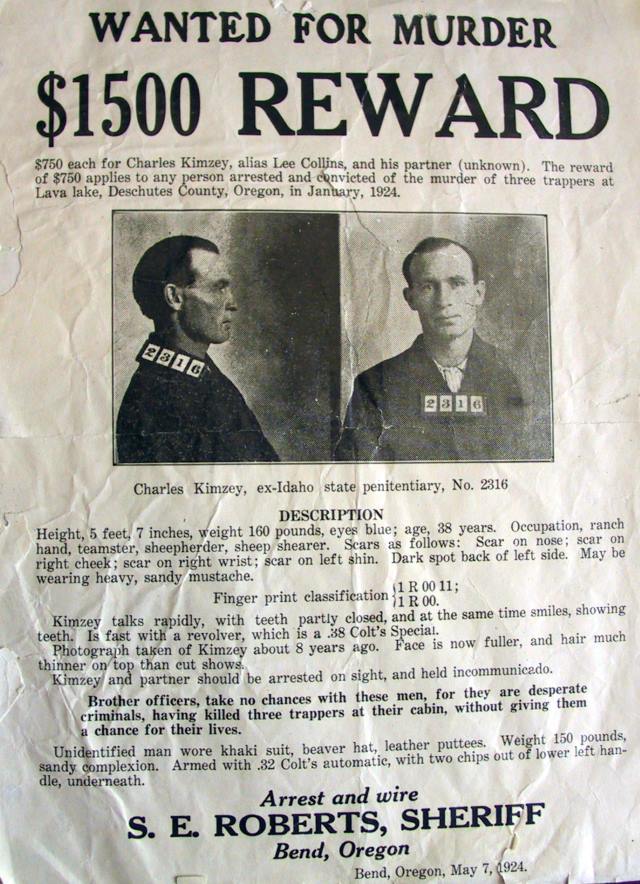
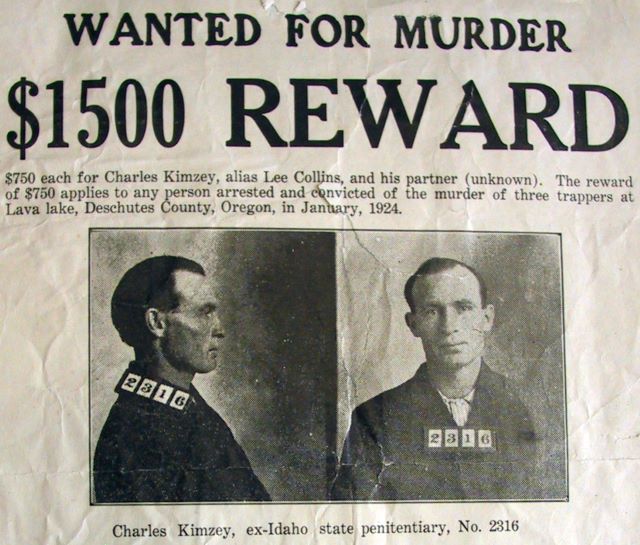
“WANT IDAHO CONVICT” – April 24, 1924 The Bend Bulletin – Suspicion was immediately cast towards Charles Kimzey, alias Lee Collins. He knew the country, was aware of the prized fur foxes at the lake and in August 1923, just before disappearing from the area, had robbed Nichols, burgled Logan’s home, left Harrison for dead after stealing his taxi and had sworn revenge on Nichols. Sheriff Samuel E. “Bert” Roberts circulated a wanted poster throughout the state. The news spread like wildfire in the west.
In Portland, traffic policeman W.C. Bender saw the wanted poster and recognized Kimzey as one of two men who had asked him for directions to a fur store around January 20, 1924. Kimzey and the other man were carrying a gunny sack of furs. Bender was positive of his identification because of a peculiar mannerism in Kimzey’s walk and the way he slurred the endings of his words. Kimzey and his partner were directed to the Schumacher Fur Company on SW 3rd and Salmon. Carl Schumacher recognized Kimzey’s mug shot as one of the men he purchased furs from on January 22, 1924. When he asked for identification he was shown Ed Nichols’ trapper’s license. The second, unidentified trapper was described as a 150 pound man with a sandy complexion, wearing a khaki suit, beaver hat and leather puttees.
The manhunt for Kimzey and his accomplice fizzled out. Even though rewards of $750 each for Kimzey and the unknown accomplice were offered, the wanted men had disappeared.
December 1925 Murder – In December of 1925 a Salt Lake City, Utah, architect directed an employee, H. R. Howard, to drive his car from Salt Lake City to his winter residence in Tampa, Florida. Howard placed an advertisement in the paper to have someone share driving duties with him. Howard disappeared and the car was found in Texas. Later, police agencies and private investigators concluded that Kimzey was the man who answered the ad. Howard’s remains were found in December 1927 in the desert south of Las Vegas. He had been stabbed in the abdomen and thrown into a draw.
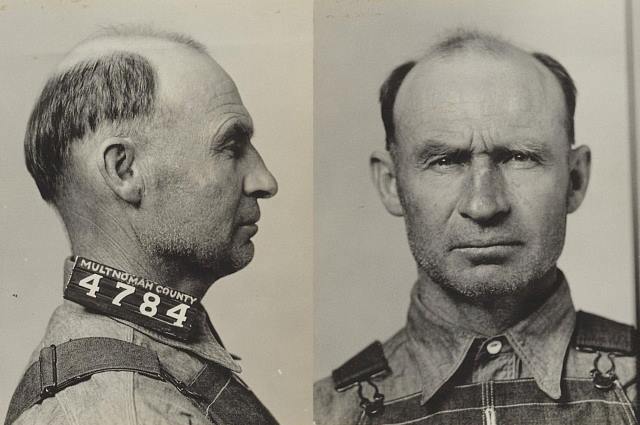
“KIMZEY IS BACK IN BEND AFTER 9 YEAR SEARCH” – March 17, 1933 Bend Bulletin headline – During the ensuing years, Deschutes County Sheriff Bert Roberts and his successor Sheriff Claude McCauley continued to follow leads about Kimzey’s whereabouts. In February 1933 a vagrant, Bob Bales, believed to be Kimzey, was arrested in Kalispell, Montana but photos and fingerprints proved he was the wrong man. Then a simple twist of fate occurred as a Kalispell jailer recognized the real Charles Kimzey walking down the street a couple weeks after Bales was released.
Kimzey was brought to Bend and had an alibi that he was working at the Moffat Railroad Tunnel Project in Colorado in January of 1924. Sheriff McCauley examined Moffat pay sheets that showed “Lee Collins” had worked on the tunnel that winter, but he had drawn his pay and quit on January 6, 1924. Additionally, McCauley interviewed a trapper in Prineville who was acquainted with Kimzey and saw him passing through the area in January 1924. He identified Kimzey on the wanted poster and said Kimzey was on horseback and stated that he was heading to Cultus Lake (6 miles southwest of Little Lava Lake) to meet a partner.
The silver bullet for the case was to be an identification of Kimzey by Officer Bender and Mr. Schumacher. Kimzey was driven to Portland and housed in the Multnomah County jail.
The two witnesses viewed a lineup and neither could positively identify Kimzey. Schumacher said that after a lapse of 9 years, he thought it was the same man but Kimzey had aged considerably and grown quite bald. McCauley later wrote that, in private, Schumacher told him “”l know that’s the man. But it’s nine years since l saw him and I’d hate to send a man to the chair on what I can remember of a casual customer l bought a few furs from that long ago…”
The Harrison Trial – Kimzey’s murder trial was ruined now, but Sheriff McCauley had other charges he could bring up – the assault, robbery and attempted murder of taxi driver W.E. Harrison in August 1923. To Kimzey’s astonishment, Harrison had survived the attack and positively identified Kimzey as his assailant. On April 22, 1933 the jury found Kimzey guilty of assault and robbery and the judge sentenced him to life in prison. The severity of the sentence was due to the court’s observation that he was a habitual criminal. Kimzey was sent to the Oregon State Prison in Salem. In 1945 he escaped from a work crew but was captured a week later. After serving 24 years in prison he was paroled in 1957, aged 71. He returned to Idaho where he died in 1976 at the ripe old age of 90
Unsolved Mystery – After 100, years this murder can still be summarized by coroner’s inquest conclusion “…these men were killed by a person or persons unknown”. Clyde McCauley was sure it was Kimzey owing to his reputation of a violent and unscrupulous poltroon. While the evidence strongly suggests Kimzey as one assailant, no mention was ever made publicly of whom Kimzey’s partner may have been.
In her book The Trapper Murders, author Melany Tupper makes a case of it being one Ray Van Buren Jackson, a sadistic schoolteacher and ex-con from Silver Lake who was in the vicinity of numerous unsolved murders in eastern Oregon through the early 1900s and died by his own hand in 1938. Besides Tupper’s book, other accounts of the events include an unpublished account of the murders co-written by Paul Hosmer and Sheriff Clyde McCauley titled “Midwinter Murders”. The book Little Known Tales from Oregon History, Volume III contains an account written by Don Burgderfer and Jim Crowell summarized the events in the 2012 edition of The Deschutes Pioneers Gazette.

Nichols, Morris and Wilson will forever go down in local history as the “Three Trappers”. Three
adjacent buttes about 6 miles east of Crane Prairie were named the “Three Trappers” in the 1920s in memory of these men. And in Bend’s Greenwood Cemetery the Three Trappers were laid to rest, side by side, as they had lived and died together in 1924.