

By Vanessa Ivey
Before Bend had The Bulletin, or was laid out between Bond and Wall Streets, the tiny community had a post office, established in 1886. The story goes that John Sisemore applied for a post office under the name of “Farewell Bend.” That name was already in use, so the Postmaster General dropped the word Farewell, and hence Bend was born. In 1899, the postmaster position passed to Sisemore’s neighbor, rancher William Staats.
Mail addressed to Bend, Farewell Bend, or even Deschutes, arrived by stagecoach to Staats’ two-story house sitting next to a bend in the Deschutes River. The owner of the house, William Staats, came to the area around 1880 and two decades later his homestead had become one of two relay points along the Prineville-Silver Lake stage route, a place for drivers to hitch up fresh horses and drop off mail. Residents today will recognize this site as Miller’s Landing Park. “Stages operated north and south daily, one leaving Prineville in the morning and the other leaving Silver Lake. These stages usually met in Bend,” Staats recalled. (The Bulletin, 2/17/27)
A Growing Community
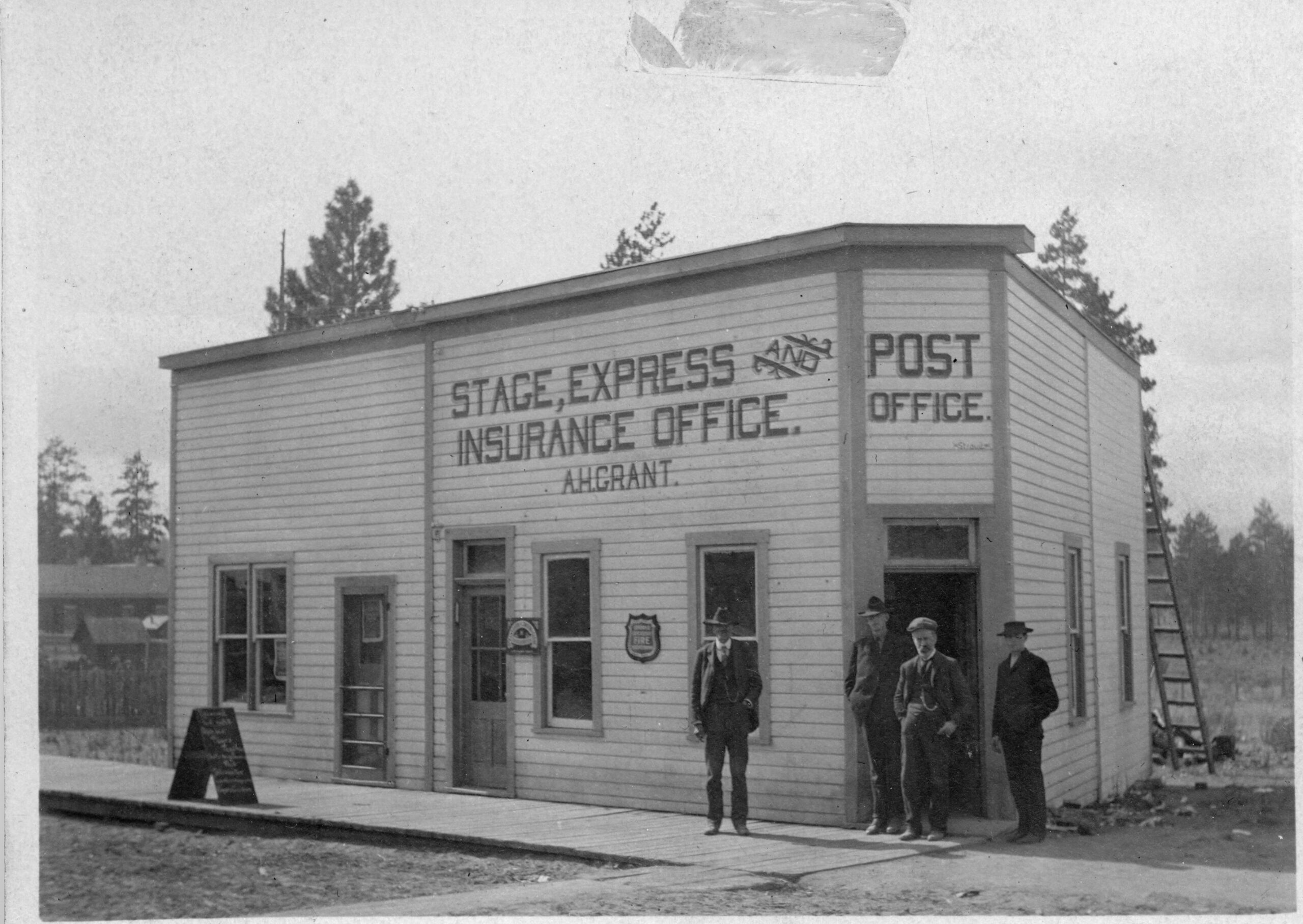
The townsite of Bend was changing. By the end of 1904 the community had become incorporated, and the residents numbered over 300 strong. The post office by the river closed and a new post office was raised within the city’s limits, across from the Pilot Butte Inn on the southwest corner of Newport Avenue and Wall Street. “The new post office, though not yet fully equipped and formally opened, is doing a flourishing business in registered mail” (The Bulletin, 4/15/1904). Within a year of opening, Bend’s post office was designated as a distributing point for incoming mail, serving its citizens and those of the communities nearby, including the newly established offices in Tumalo and Laidlaw, and later that year Redmond. The area was growing and with it the postal needs of its population.
Over the next fifteen years Bend’s post office relocated four times throughout downtown, before finding residency at the O’Donnell brothers’ newly constructed brick building at 923 Wall Street, the current location of Jack and Millie’s clothing store. “Wall Street will again become the home of the Bend post office on Sunday, January 18.” (The Bend Bulletin, 1/15/1920). However, Bend’s growth wasn’t slowing down, and city officials knew a permanent solution with more space would be required soon.
Three years earlier, in January 1917, Judge J.A. Eastes sent a letter to Washington D.C. urging US Senator Harry Lane, OR-Democrat, to grant the construction of a federal building in Bend. In his letter Eastes pointed out that Bend was quickly reaching a population of 5,000. He estimated postal receipts for 1917 were $25,000 up $5,000 over the previous year. Bend was rapidly becoming the distributing point for all Central Oregon. In fact, with the railroad’s arrival in 1911 and two super pine mills operating along the Deschutes River since 1915, it isn’t surprising that Bend reached a population of 5,400 by 1920. That was a 910% increase between 1910 and 1920, resulting in the largest population boom the city has seen to date.
A month after J.A. Eastes sent his letter, he received an answer from Senator Lane, assuring him that, “the entire Oregon delegation in both houses of Congress is favorable to the appropriation, and that no official intimation has yet been made that President Wilson will veto the Public Buildings appropriation bill, in which the Bend item has been introduced.” (The Bulletin, 2/12/1917)
President Wilson never signed the building bill. Instead, on April 6, 1917 Wilson formally declared war against Germany and the United States entered World War l, redirecting designated building funds to the war chest. In 1926 US Congress tried again to pass an appropriation bill for much needed funding for the financing and construction of federal buildings across the United States, and the bill passed in both the House and the Senate. On May 25, President Coolidge signed the measure into law.
The Public Buildings Act of 1926 set aside $165 million for the funding and construction of federal buildings throughout the United States. One provision was that $100 million would be used to construct federal office buildings and post offices throughout the country. The projects would be under the supervision of the United States Secretary of the Treasury, assisted by the Postmaster General. This kicked off a whirlwind of new construction across the country. Many of those buildings are still standing and in use including the US Supreme Court and the National Archives buildings.
Days before President Coolidge signed the bill into law, Bend’s Chamber of Commerce received a telegram from US Senator R.N. Stanfield: “This means Bend must submit evidence to the secretary of treasury and postmaster general showing extreme need for a building now. I will cooperate with you to the fullest extent in making a strong presentation of your need,” Stanfield concluded. (The Bulletin, 5/20/1926)
Data was collected and written up, and along with possible building site surveys, submitted to the US Treasury Department. On January 1, 1931, nearly five years after the Public Building Act of 1926 was signed into law, Bend received formal notification from of its approval for a federal building.
Launching the Project
The federal officers inspecting the fifteen proposed sites for the new building selected four lots at the corner of Wall Street and Franklin Avenue for the new federal building. The owners were William Staats, Bend’s retired postmaster, J.N. Hunter, and P.B. Johnson.
The Bulletin reported a total project cost of $155,000; $15,000 for the site, and $140,000 for the building and furnishings. Plans for the 2-story building showed the post office on the main floor and headquarters for the Deschutes National Forest on the second.

Planning and construction of the federal building was snail-paced to start. Standing on the chosen property was a building constructed in 1903. Known as the Lawrence building, it had once been occupied by Dr. Charles Spencer Edwards, the second home of the Bend Bulletin, the city library, and a repair shop. In 1931, the tenants included the Salvation Army, Mrs. Basset who operated boarding rooms, and a Singer sewing machine business. This and the pavilion just to the north of the building were required to be vacated and razed before construction could begin.
The Treasury Department was very particular about the look of the building. The plans, comprising over 26 large blueprints, included 121 pages of detailed specifications. The two-story building’s exterior was to be terra cotta, with a basement and front steps of granite. The entrance to the building would be off Wall Street. Construction bids opened Feb 9, 1932, with submissions made to Washington D.C. from across the country. The government’s interest in using local builders ensured a timely start to the project. The winning bidder would have 360 days to complete the project from the time they were notified. Charles Weitz’ Sons, Inc., of Des Moines, Iowa, was awarded the general contractor, with a low bid of $97,386. Construction began in April 1932.
Local Work
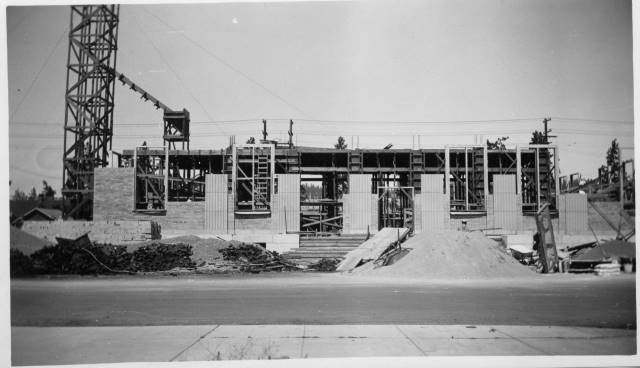
At a time when jobs were scarce and unemployment was high; the city’s public building contract provided an opportune boost to the local economy. Charles Weitz’ Sons hired locals as subcontractors. Using local materials whenever possible, they transformed the corner at Wall and Franklin from a bare lot into a “Federal Presence.”
Fred Van Matre did the excavation work. The removed basement rock was used in Harmon Park as fill dirt extending the park out along the footbridge, and in the creation of a “sea wall” near the north end of the riverfront. William Montgomery received the plumbing and heating contract. Electrician Lloyd Robinson wired the building. The local sand and gravel were secured from James Crawford.

What a surprise the government must have had upon learning that billions of fossils were used in the construction of their building: “Mined at Lower Bridge…Approximately three tons of the [diatomaceous] white earth, composed of the silica covering of minute, one-celled plants which flourished in a Deschutes lake thousands of years ago will be used on the Bend building. It will form an important part of all structural concrete placed in the Bend building.” (The Bend Bulletin, 7/20/1932)
Of course, Bend being home to two of the largest pine mills in the nation, it was only natural to incorporate Central Oregon’s wood products into the construction of the building. Showcasing the local species contributed to the overall interior beauty of the building.
Once the basement and cement work were complete, momentum on the rectangular, 17,306-square-footstructure quickened. April 22, 1933, The Bulletin announced the closing of post office services in the O’Donnell building. “Shortly before the window of the old post office closed today noon, for the last time, Miss Jane Ryan of the Magill Drug Co., received the last stamps sold in the quarters in the O’Donnell building.” Simultaneously, less than a mile south, was the distribution of the first letter at the new post office to Charles Shaw. A day earlier the forest service staff had moved from their offices in the O’Kane building to their new location on the second floor of the United States Federal Building. Although the building would not be completed for another two months, it was certainly ship-shape and ready for business come Monday morning April 24, 1933.

“NEW BUILDING IS VISITED BY 2,000” The Bend Bulletin heralded across the Saturday May 12, 1933, morning edition. The open house had been a success. Mrs. George Sedgwick, the only woman member of the postal staff in Bend, greeted visitors as they streamed through the building, touring rooms in unbroken lines. Every nook and cranny was exposed to the public. From the basement’s “swing room”- a 1930s break room; combination lounge, locker room, and changing area, where postal workers hung out between shifts; to the “catwalk”- a small four-foot room overhanging the first floor discreetly designed with “peep holes” where inspectors checked the honesty of postal workers. With only the landscaping left to be completed, the government checked the project as done in June, several months over schedule, but far exceeding expectations.
Changing Purpose

At the onset of war in 1942, rooms in the federal building were transitioned for the war efforts and civilian services. It didn’t take long for the post office to outgrow its residence and when the US Forest Service moved elsewhere in the mid-40s, the mail operations took over the building completely.
But like all things, age catches up and change is constant. The increased volume and demands on the post office became too much for the older building, insufficient technology and space became a problem. The US Federal Post Office building served the residents of Bend from 1933 to 1978. The main post office moved to 2300 NE 4th Street in 1978 and a few years later the downtown classified branch moved to a new smaller location off Oregon Avenue, closing the service window at the corner of Franklin and Wall building permanently. Today, Bend’s mail is still sorted, accepted, and delivered through both the 4th Street and Oregon Avenue branches.
So, what happened to the United States Federal Post Office building on the corner of Wall Street and Franklin Avenue? Although showing its age, the American classicism-style architecture, with its columns of concrete and granite stairway found new purpose in 1985. The building was added to the National Register of Historic Places, receiving recognition as a historic and cultural resource.
In 2001, the Bend Chamber of Commerce moved into the building occupying the old post office’s territory. Today it continues to stand. After a major renovation giving new life and purpose to a splendid building, it has become the home to the Westman Hotel, named for Oregon’s first female postal carrier, Minnie Westman. Inside The Westman Hotel in Bend’s Historic Post Office — Bend Magazine
